If you've ever pulled an espresso shot that tasted incredible, then tried to repeat it the next day and got something completely different, the answer is almost always the same: you didn't measure. Coffee is a recipe, and the foundation of any recipe is a scale. Here's why 0.1g precision matters, what features to look for, and how a proper scale fixes most "inconsistent home brewing" problems in a single purchase.
The math problem nobody tells you about
Coffee strength is a ratio. A standard espresso is 1:2 (18g of coffee yields 36g of espresso). A standard pour-over is 1:16.7 (18g of coffee, 300g of water). These aren't snobby specifics — they're the difference between balanced and broken extraction.
Here's the problem: a "tablespoon" of coffee can weigh anywhere from 5g to 9g depending on bean density, roast level, and how heaped the spoon is. Volume measurements give you a 40% margin of error before you've even ground the beans. Your shot is doomed before water touches the puck.
A scale takes that 40% variability to roughly 0%.
Why 0.1g matters specifically
You'll see kitchen scales advertised at 1g resolution and coffee scales at 0.1g. The difference matters more for espresso than pour-over, but it matters in both cases.
For espresso
A typical double shot is 18g of grounds. The difference between 18.0g and 18.9g is roughly 5% — enough to push a shot from balanced to under-extracted. With a 1g-resolution scale, you can't tell the difference; the readout will say "18g" for anything from 17.5g to 18.4g.
For the output, the difference is even tighter. A 1:2 ratio means your shot ends at 36g. If your scale rounds, you're reading anywhere from 35.5g to 36.4g — that's a real ±2.5% error on the brew strength. Compounded over input + output, you've got 7% slop in the recipe before you've considered grind, temperature, or pressure.
For pour-over
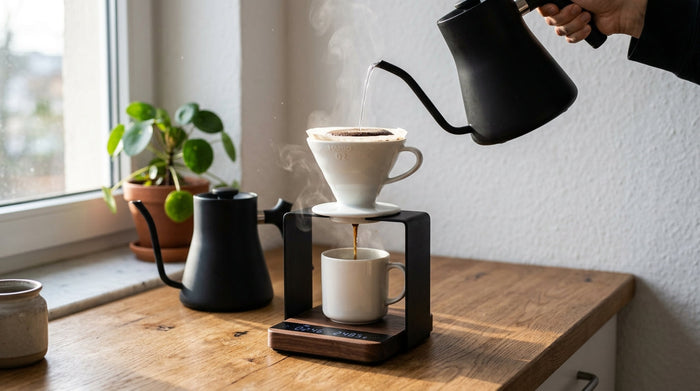
The total water amount is larger (300g vs 36g for espresso), so a single 1g imprecision matters less in percentage terms. But pour-over scales also need to handle the pour — you're watching the weight increase in real time and stopping at exact thresholds (e.g., "stop pouring at 150g for the bloom"). At 1g resolution, the scale updates in chunky steps; you'll regularly overpour by 5–10g because you saw the readout late.
0.1g resolution gives smooth, real-time feedback. You can stop on the gram every time.
The four problems a scale fixes
Problem 1: "My shot tastes different every day"
You're not weighing input, output, or both. The single biggest source of shot-to-shot variance in home espresso is dose variability. A scale eliminates this in 5 seconds: weigh the beans before grinding, dose to your target weight (e.g., 18.0g), then weigh the espresso output to your target ratio (36.0g). Same recipe, same result, every morning.
Problem 2: "I can't tell if my pour-over is balanced"
If you don't know your input weight, you can't compute your ratio, which means you can't tell if the bitter cup you got was over-extraction (grind too fine), too much coffee (over-dosing), or wrong water temperature. Each fix is different. A scale isolates the variable so you can troubleshoot the right thing.
Problem 3: "I keep over-pouring on bloom and ruining the brew"
The bloom phase of pour-over is the first 30 seconds where you wet the grounds and let CO2 escape. If you over-pour the bloom (say, 80g of water on 18g of coffee instead of the target 50g), you've started extraction too early and the cup will be unbalanced. A scale + timer combo lets you nail the bloom precisely.
Problem 4: "My espresso ratio is somewhere between 1:1 and 1:3 depending on the day"
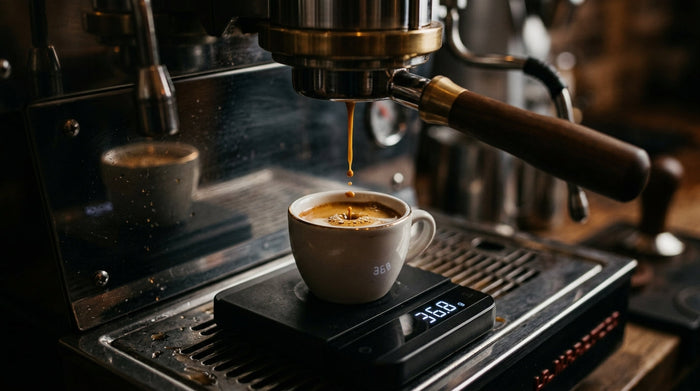
Without a scale on the drip tray, you're eyeballing the espresso volume in the cup — and crema makes it look like more liquid than there actually is. A scale under the cup tells you exactly when to stop the shot. Pull at 1:2 every time.
Features that actually matter
Built-in timer (non-negotiable)
A coffee scale without a timer is a kitchen scale, not a coffee scale. You need both readouts simultaneously: weight and elapsed time. Auto-start (begins when liquid hits the scale) is a nice-to-have; manual start works fine.
Without an integrated timer, you're either pulling out your phone for a stopwatch (friction) or guessing at brew time (defeats the point of weighing in the first place).
0.1g resolution
As discussed above. Don't compromise on this — it's the entire reason to buy a coffee scale.
2000g+ capacity
You need enough capacity for the heaviest brew you'll make: a full 1L pour-over carafe sitting on the scale is around 1100g of water plus the carafe. A scale with 1000g max can't handle this. 2000g is the standard for safety margin.
Fast response time (under 200ms)
The readout has to update faster than you can pour. Slow scales lag the pour by half a second, and by the time you see "150g" you're already at 158g. Look for "fast response" or 100–200ms in the spec sheet.
Splash-resistant surface
Coffee drips. A scale that can't be wiped clean (or worse, has crevices that collect liquid) won't last six months on your counter.
USB rechargeable, not battery-powered
Daily-use scales burn through coin batteries in 2–3 months. USB rechargeable scales charge once a week and never let you down. Plus you can use the same cable as your phone or laptop.
Compact footprint
Coffee scales need to fit on the espresso machine drip tray under the portafilter spouts. Look for a profile under 130mm wide and under 30mm tall. Anything bigger and your portafilter won't sit over it.
Features that don't matter (much)
- Bluetooth/app connectivity: the data is interesting once; nobody actually uses the app long-term.
- Multiple unit modes (oz, fl oz, g): use grams. Always grams. Coffee recipes are universal in metric.
- Built-in brewing recipes: gimmicky. The 4-pour pour-over recipe is just "bloom + 3 pours at fixed weight intervals" — no app needed.
- Touch-sensitive buttons that look fancy: hard to press with wet hands. Physical buttons are better.
Setup and use
For espresso
- Place scale on drip tray, cup on top of scale.
- Press tare (zero) to ignore cup weight.
- Press timer start as you start the shot.
- Watch both weight and time as the shot pulls.
- Stop the shot when you hit your target weight (e.g., 36g for a 1:2 ratio from 18g input).
- Note the time. A typical shot finishes between 25–32 seconds.
For pour-over
- Place dripper + carafe on scale.
- Add filter, rinse with hot water (waste this water — it removes paper taste).
- Empty carafe, return to scale.
- Add ground coffee to filter, tare to zero.
- Start timer, begin bloom pour to your target (e.g., 50g for 18g of coffee).
- Continue pours at marked time intervals, watching the weight readout for each target.
The setup you actually need
For most home setups, the right scale is a single device that handles both espresso and pour-over, with 0.1g resolution, built-in timer, USB rechargeable, and a footprint small enough to fit on a drip tray.
Our Precision Coffee Scale with Timer hits all of these: 0.1g accuracy, 2000g capacity, built-in countdown timer, USB-C rechargeable (1600mAh battery lasts ~2 weeks), available in Black or White to match any kitchen aesthetic.
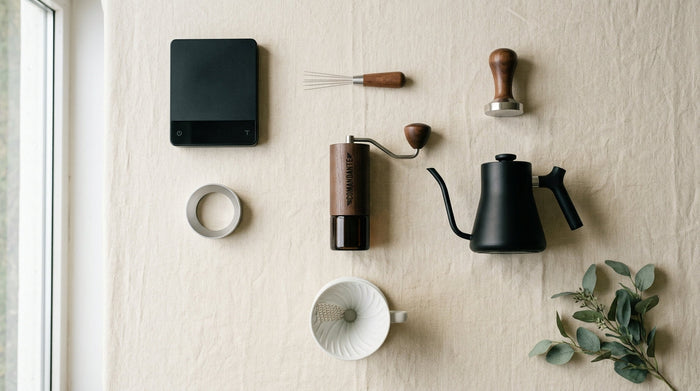
Pair it with a WDT tool and a calibrated tamper and you've got the three tools that fix 90% of espresso variability — for under $130 total.
FAQ
Can I use a regular kitchen scale?
For pour-over, a kitchen scale with 1g resolution and a stopwatch app will work in a pinch — you'll just be 5–10g imprecise on each pour. For espresso, 1g resolution is too coarse; you really need 0.1g.
How long does the battery last?
USB rechargeable coffee scales typically last 1–3 weeks of daily use per charge. Our scale runs about 2 weeks at 2 brews/day before needing a charge.
Does the scale work if it gets wet?
The top surface is splash-resistant — wipe up drips and you're fine. Don't submerge it. If liquid gets into the buttons, dry the surface and let air-circulate for an hour before pressing again.
Why does my scale's reading drift?
If your scale is on an uneven surface or near vibrations (running fridge, dishwasher), the load cell will fluctuate. Move to a stable counter and tare again before each brew.
Should I weigh by grams or ounces?
Grams. All published coffee recipes use grams, and 0.1g resolution doesn't translate cleanly to fluid ounces. Switch your scale to grams once and don't touch it again.
The single tool that pays for itself
If you spend $5 on a daily café coffee, that's $1,825 a year. A $50 coffee scale is 1% of that — and it's the tool that makes home coffee actually competitive with what you'd pay $5 for. Most people skip it because "it's just a scale," then wonder why their shots are inconsistent.
It's not just a scale. It's the foundation that every other variable depends on. Buy it first, before the fancy grinder, before the upgraded machine. The rest of your gear works better when the dose is right.