A tamper that doesn't match your portafilter is one of the most expensive small mistakes you can make in home espresso. Buy the wrong diameter and you'll get loose pucks, channeling, and shots that taste hollow no matter how good your beans are. Get it right and the rest of your brewing variables actually start to matter.
The good news: there are really only three sizes you need to know about. The bad news: nobody tells you which one your machine takes until you've already ordered the wrong one. This guide fixes that.
Why tamper size matters more than you think
Espresso extraction is a precision game. Water at 9 bars of pressure looks for the path of least resistance through your puck of ground coffee. If your tamper is even 0.5mm smaller than your basket, water will slip down the gap between the puck edge and the basket wall — that's "channeling," and it's the #1 cause of sour, uneven shots.
The fix isn't pressing harder. It's matching your tamper diameter precisely to your basket so the puck seals against the wall on every shot.
The three sizes that cover 95% of home machines
51mm — entry-level home machines
The 51mm size belongs to most starter machines: De'Longhi Dedica, De'Longhi La Specialista (with stock pressurized basket), Gaggia Classic Pro (stock), Mr. Coffee, and many capsule-compatible machines. If you bought your machine for under $400 and didn't upgrade the portafilter, you're almost certainly on 51mm.
Note: Many entry-level machines ship with pressurized baskets that artificially create pressure regardless of grind. If you've upgraded to a bottomless or non-pressurized basket, you may need a different size — measure the basket inside diameter to confirm.
53mm — Breville's prosumer line
This is Breville territory: the Bambino, Bambino Plus, Barista Express, Barista Pro, Barista Touch, and Dual Boiler all use 54mm baskets — but a 53mm tamper is the right fit (you want roughly 1mm clearance for the puck to expand under pressure). Some semi-commercial machines also use 53mm.
If you're not sure whether you have a 53mm or 58mm setup, this is the size most often confused on Breville machines. Look at the portafilter diameter, not the basket — Breville's portafilter spout is 54mm, but the tamper fits the basket inside.
58mm — prosumer and commercial standard
The 58mm size is the industry standard for prosumer and commercial machines. If you have a Rancilio Silvia, Rocket Appartamento, ECM Synchronika, Profitec Pro 500, La Marzocco Linea Mini, Lelit Bianca, Slayer, or any commercial setup, you're on 58mm.
A few prosumer Breville machines (the Dual Boiler) also use 58mm if you've swapped to commercial-style baskets. When in doubt, 58mm is the safer assumption for any machine over $1,000.
Compatibility table — the 20 most common home machines
| Machine | Tamper Size |
|---|---|
| Breville Bambino / Bambino Plus | 53mm |
| Breville Barista Express / Pro / Touch | 53mm |
| Breville Dual Boiler (stock) | 53mm |
| Breville Dual Boiler (commercial baskets) | 58mm |
| De'Longhi Dedica EC685 | 51mm |
| De'Longhi La Specialista (stock) | 51mm |
| De'Longhi La Specialista Maestro | 58mm |
| Gaggia Classic Pro (stock) | 51mm |
| Gaggia Classic Pro (with bottomless mod) | 58mm |
| Rancilio Silvia / Pro / X | 58mm |
| Rocket Appartamento / Mozzafiato | 58mm |
| ECM Synchronika / Mechanika | 58mm |
| Profitec Pro 500 / 600 / 700 | 58mm |
| La Marzocco Linea Mini / GS3 | 58mm |
| Lelit Bianca / Mara X / Elizabeth | 58mm |
| Ascaso Steel / Dream | 58mm |
| Quick Mill Andreja / Silvano | 58mm |
| Slayer Espresso (any) | 58mm |
How to verify your size if you're not sure
- Remove your portafilter from the machine and pop out the basket.
- Measure the basket's inside diameter at the top with a ruler or calipers. The exact diameter of the inside lip is your tamper size.
- Subtract 0.3–0.5mm for clearance. So if your basket measures 58.5mm inside, you want a 58mm tamper. If it measures 53.5mm, you want a 53mm.
- Don't trust the portafilter exterior measurement — that includes the metal wall thickness and is not your tamper size.
Pro tip: Many enthusiast machines have both a stock pressurized basket and a non-pressurized basket included. The two have different inside diameters. Use the non-pressurized basket measurement for serious espresso work.
Other dimensions that matter
Base style: flat vs. convex (curved) vs. ripple
Once you have the right diameter, base style is mostly preference:
- Flat bottom — most popular, gives even pressure across the puck, easiest to learn with.
- Convex (curved) — slightly domed base; some baristas claim it improves edge sealing. Marginal difference for most home setups.
- Ripple — textured base meant to break up clumps as you tamp. Gimmicky for most users — a separate distribution tool does this job better.
Our recommendation for 90% of home baristas: a calibrated flat-bottom tamper paired with a separate distribution tool.
Calibrated vs. standard tamping
Inconsistent tamping pressure (typically anywhere from 15 lbs to 50 lbs across different attempts) is one of the biggest sources of shot-to-shot variance. A calibrated tamper — one that clicks at a fixed pressure point or has a self-leveling base — removes this variable entirely.
If you're still developing your tamping technique, a calibrated tamper is the single biggest upgrade you can make. Our Self-Leveling Tamper auto-corrects for angle and applies consistent pressure regardless of how hard you press.
The full puck-prep workflow
Tamping is the last step in a sequence. To get the most out of any tamper, build the full workflow:
- Dose — weigh your grounds (typically 18g for a double basket).
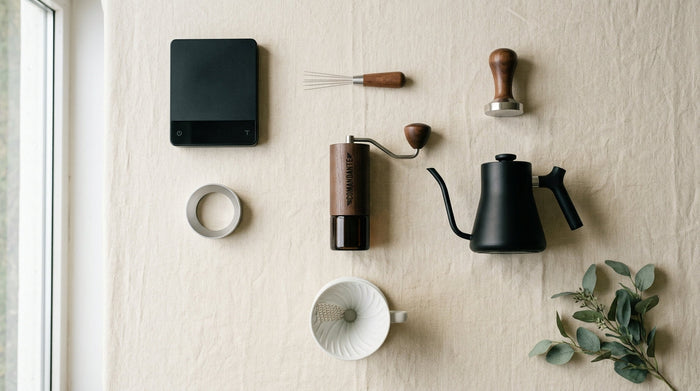
- Distribute — break up clumps with a WDT needle tool or rotating distributor.
- Level — tap the portafilter gently to settle grounds.
- Tamp — apply consistent, level pressure with a tamper sized to your basket.
- Inspect — the puck surface should be flat, smooth, and slightly glossy. No cracks or low spots.
Each step compounds. Skipping any one of them — including using the wrong tamper size — bottlenecks the rest.
FAQ
Can I use a 58mm tamper on a 53mm basket?
No. The tamper won't fit inside the basket. You'll need a 53mm tamper.
What if I use a 53mm tamper in a 54mm basket?
The 1mm gap will cause channeling. Water will rush down the sides of the puck instead of evenly through it, producing sour, weak shots.
Are aluminum and stainless steel tampers different?
Stainless steel is denser and gives the tamper more weight, which makes self-leveling and gravity-feed designs work better. Aluminum is lighter and cheaper but less satisfying to use. For under $50, stainless is worth it.
Does the tamper handle material affect the shot?
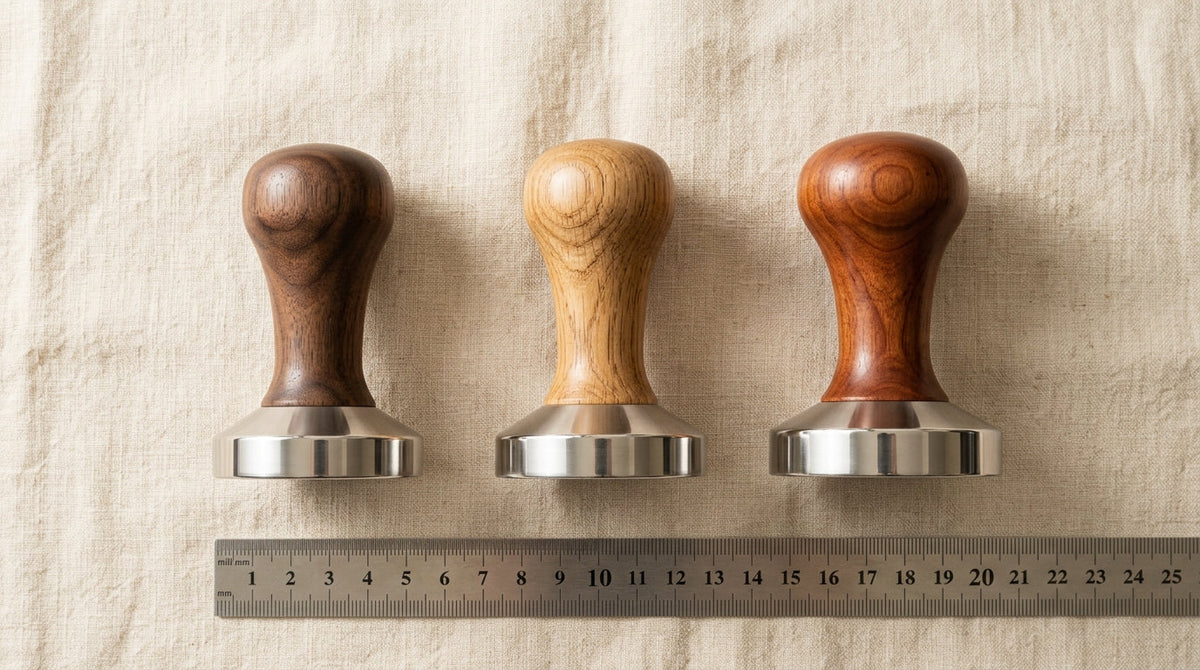
No — handles are pure ergonomics and aesthetics. Wood feels warm and looks great; metal is durable; carbon-fiber-textured surfaces don't slip in wet hands. Pick what you'll enjoy holding every morning.
The TrueShih tamper recommendation
For home baristas dialing in their first prosumer setup, we recommend the Self-Leveling Espresso Tamper. Available in 51mm, 53mm, and 58.35mm, it auto-corrects pucks for level and removes inconsistent pressure as a variable. Pair it with our WDT Needle Tool for the complete puck-prep workflow — the same workflow used by World Barista Championship competitors, simplified for your kitchen counter.
Match the size to your machine, build the workflow once, and stop wondering why your shots taste different every morning.