A $15 tin of "ceremonial matcha" at a wellness store and a $60 tin from a specialty tea importer often look identical from the outside. Inside, they're not even the same product category. One is ground tea leaves; the other is a specific cultivar of shade-grown, stone-milled spring harvest from Uji or Nishio. Knowing the difference saves you from drinking expensive pond water.
This guide breaks down the four grades you'll see on shelves, what each is meant for, and what to actually pay. By the end, you'll be able to read a tin and know whether the price tag matches the contents.
The four grades you'll see (in plain English)
Ceremonial grade — for traditional preparation (whisked with water)
What it's for: drinking straight, whisked with hot water in a chawan bowl. The traditional Japanese tea ceremony preparation.
- Color: vivid jade green, almost neon
- Taste: sweet, umami, smooth — no bitterness
- Texture: ultra-fine, talc-like; no gritty mouthfeel
- Price (per 30g tin): $30–60 USD for genuine Japanese ceremonial
- Made from: first-flush spring harvest, shade-grown 20+ days, stone-milled
If you're whisking matcha with just water (the traditional preparation), this is what you want. Anything less and the bitterness will overwhelm without sugar or milk to mask it.
Premium / "ceremonial-style" — daily drinker
What it's for: same as ceremonial but every day without breaking the bank.
- Color: bright green, slightly less vivid than top ceremonial
- Taste: mild umami, slight grassy note, very low bitterness
- Texture: fine, but you may detect slight grit at the bottom of the bowl
- Price (per 30g tin): $20–35 USD
- Made from: first or second flush, shorter shade time, often stone-milled
This is the sweet spot for most home matcha drinkers. You get authentic flavor without ceremonial pricing, and it's still good enough to drink straight.
Latte grade — built for milk and ice
What it's for: matcha lattes, iced matcha, smoothies. Anything where milk or sweetener masks the base flavor.
- Color: green but duller, sometimes slightly yellow-green
- Taste: mild bitterness, less umami, more grassy/vegetal
- Texture: noticeably grittier than ceremonial
- Price (per 30g tin): $12–22 USD
- Made from: later harvests, shorter shade, machine-milled
Don't drink this one straight — the bitterness needs milk fat or sweetener to balance. But if you make 90% lattes, paying ceremonial prices is overkill: the milk flattens out the subtle umami notes anyway.
Culinary grade — baking and cooking only
What it's for: matcha cookies, cakes, ice cream, savory cooking. Not for drinking.
- Color: olive green to brownish-green
- Taste: bitter, astringent, distinctly tea-like
- Texture: coarse, sometimes visibly fibrous
- Price (per 100g): $8–15 USD
- Made from: late harvests, no shade, often non-Japanese origin
Culinary grade is fine for what it's designed for — high heat and other strong flavors mask the harshness. But if you've been drinking culinary matcha because it's cheap, you've never actually tasted real matcha.
How to spot fake premium matcha
Many tins labeled "ceremonial" at $15–20 are actually latte or even culinary grade. Here's how to tell:
The color test
Real ceremonial matcha is so green it almost glows. If the powder looks olive, yellowish, or muted, it's not ceremonial — regardless of what the label says. Vibrant green means high chlorophyll, which means proper shade-growing.
The smell test
Open a tin and inhale. Premium matcha smells fresh, sweet, vegetal — almost like fresh-cut grass plus a hint of seaweed (the umami). Lower grades smell flat, dusty, or grassy without the sweetness.
The taste test (5-second method)
Whisk a small amount with hot water. Sip without swallowing.
- Sweet finish, no bitterness = ceremonial.
- Mild bitterness that fades = premium / daily.
- Sustained bitterness = latte grade or worse.
- Astringent, makes your tongue feel dry = culinary or low quality.
The origin check
Genuine Japanese matcha will state the prefecture: Uji (Kyoto), Nishio (Aichi), Kagoshima, Shizuoka, or Fukuoka. If the label just says "Japan" without a region — or worse, says "China" or "Vietnam" — it's almost certainly not authentic ceremonial grade. Premium Japanese matcha producers are proud of their region and label it prominently.
The temperature mistake almost everyone makes
Even with $50 ceremonial matcha, boiling water will ruin it. Hot-but-not-boiling is the rule:
- Ideal water temperature: 70–80°C (158–175°F)
- Boiling water (100°C) extracts catechins (the bitter compounds) too aggressively, killing the umami you paid for.
- Easy method: boil water, then let it sit for 60–90 seconds before whisking, or pour back and forth between two cups twice to drop the temperature.
The proper preparation (it takes 2 minutes)
- Sift 1–2 grams of matcha through a fine mesh sieve into your bowl. This removes clumps that would otherwise cause lumps.
- Add 60ml of 70–80°C water.
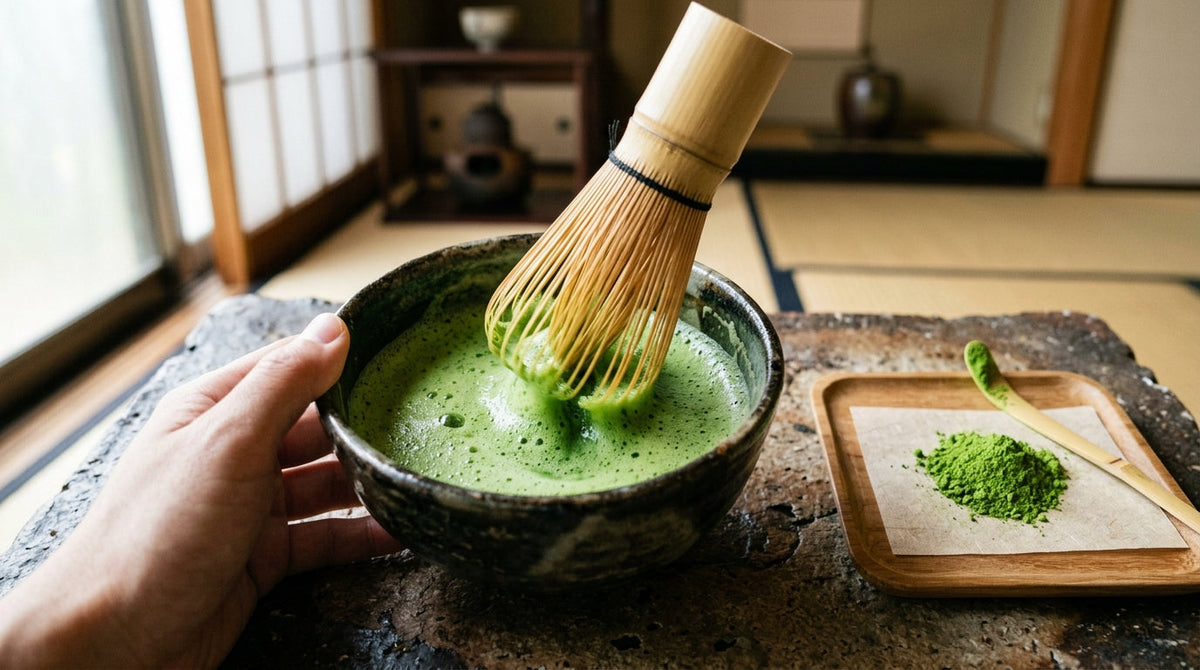
- Whisk in a fast W-motion with a bamboo chasen for 15–20 seconds. The matcha should lift to a fine froth on top — that's the crema.
- Drink immediately. Matcha settles fast; the longer you wait, the more sediment collects at the bottom.
Common mistake: using a metal whisk or spoon to mix. Bamboo chasens have 80–120 fine prongs that aerate the matcha properly; metal can't replicate this and will produce flat, uneven texture.
Storage — because you're paying premium prices
Matcha is a delicate, oxidizing product. Stored wrong, a $60 tin loses 50% of its quality in two weeks.
- Refrigerate after opening. Airtight tin, in the back of the fridge (most stable temp).
- Use within 4–6 weeks of opening. Past that, color fades and umami dissipates rapidly.
- Buy small tins. Better to buy a fresh 30g tin every month than hoard a 100g tin that goes stale.
- Bring to room temperature before opening. Cold + humid air = condensation in the tin.
The toolkit you actually need
For traditional preparation, you need a handful of well-matched tools: a chawan bowl wide enough for the whisk to move freely, a bamboo chasen with 80–120 prongs, a ceramic chasen holder to keep the prongs in shape between uses, and a bamboo chashaku scoop sized to dose 1g per scoop.
Buying these separately can cost $80–120 by the time you've curated good versions of each. Our Matcha Ritual Essentials gathers them into one five-piece set — a spouted ceramic chawan, a 100-prong bamboo chasen, a ceramic whisk holder, a bamboo chashaku scoop, and a kraft gift box — sized to work together, for $59. The spouted chawan is wide enough for the chasen to whisk freely (then pours straight into your cup), the holder keeps the prongs from splaying, and the chashaku doses the exact 1g the Uji tradition calls for.
FAQ
Is more expensive matcha always better?
Up to about $40/30g, yes — price tracks quality closely. Above $50/30g you're paying for limited-edition single-cultivar harvests, which are more about prestige than taste improvement for most drinkers.
Can I drink matcha every day?
Yes. A 2g serving has roughly 70mg of caffeine — about half a cup of coffee. Most regular drinkers have 1–2 servings/day with no issues.
Why is my matcha bitter even with good powder?
Three usual suspects: water too hot (use 70–80°C), too much matcha (start with 1g, not 2g), or whisking too slowly (the W-motion should be fast and shallow, not stirring).
Does the chasen matter that much?
Yes. Cheap chasens have 50–60 thick prongs that don't aerate properly — the matcha will be flat and gritty regardless of powder quality. A proper chasen has 80–120 fine prongs and produces a smooth, lifted crema.
Where to start
Pick one premium-grade tin from a Japanese specialty importer (look for an Uji, Nishio, or Kagoshima origin), pair it with a proper chasen + chawan kit, and follow the 70–80°C rule. That's the entire learning curve. Once you've tasted authentic matcha prepared correctly, the difference is permanent — and you'll never go back to drinking olive-green powder from a wellness aisle.