What Is WDT?
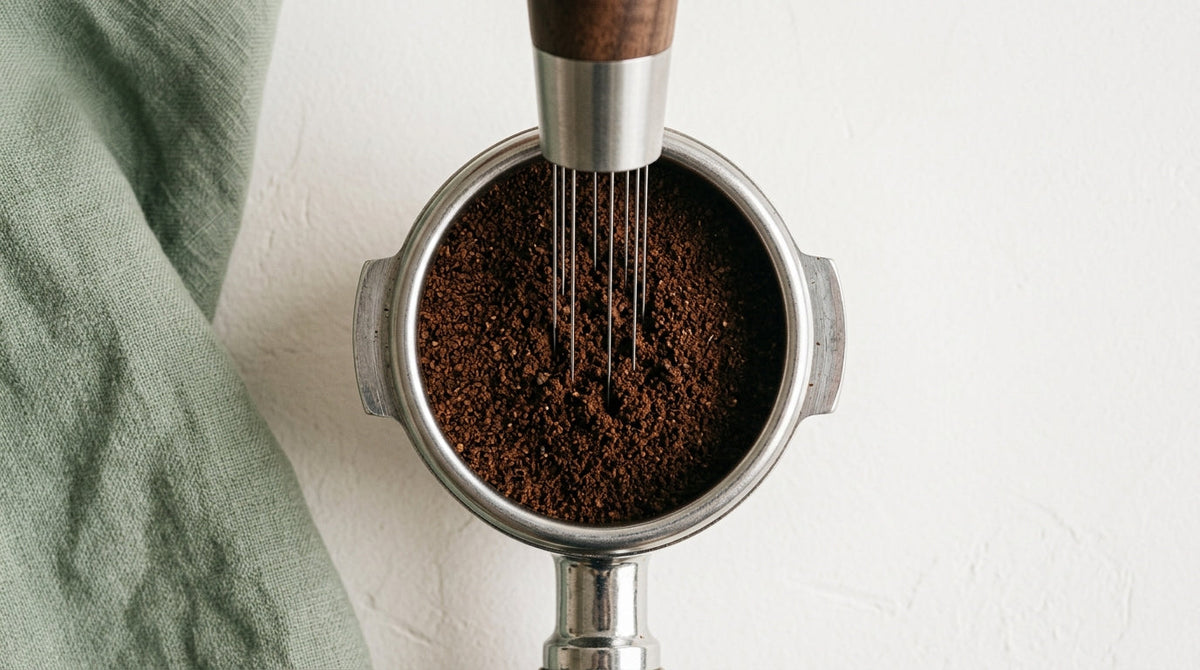
WDT stands for Weiss Distribution Technique, named after John Weiss who popularized it in the home espresso community. The technique uses thin needles to break up clumps in ground coffee before tamping, ensuring even distribution in the portafilter basket.
Why Does It Work?
Freshly ground coffee — especially from burr grinders — clumps together due to static electricity and moisture. These clumps create uneven density in your puck, which causes water to find the path of least resistance (channeling), leading to uneven extraction and inconsistent taste.
WDT physically breaks up these clumps and redistributes the grounds evenly. The result: a uniform puck, consistent resistance, and dramatically better extraction.
How to Do WDT Correctly
- Grind your dose directly into the portafilter (or use a dosing ring to prevent spillage)
- Insert the WDT tool — needles pointing down into the coffee bed
- Stir in circular motions about 10–15 times, going about 1cm deep
- Tap the portafilter gently on a flat surface to level the bed
- Tamp as normal — level, firm, consistent pressure
WDT vs. Distribution Tool: What is the Difference?
A distribution tool uses a spinning disc to level and compress the surface of the coffee bed. WDT specifically breaks up clumps before leveling. For best results, use WDT first, then a distribution tool, then tamp.
Is It Worth the Extra Step?
Absolutely. Most home baristas who add WDT to their workflow report immediately more consistent shots — same time, same ratio, same taste cup after cup. It takes about 30 seconds and makes a noticeable difference.
Get consistent espresso every time. Our WDT Needle Tool features 0.35mm precision needles. Pair it with the Rotating Needle Distributor for a complete pre-tamp workflow.